
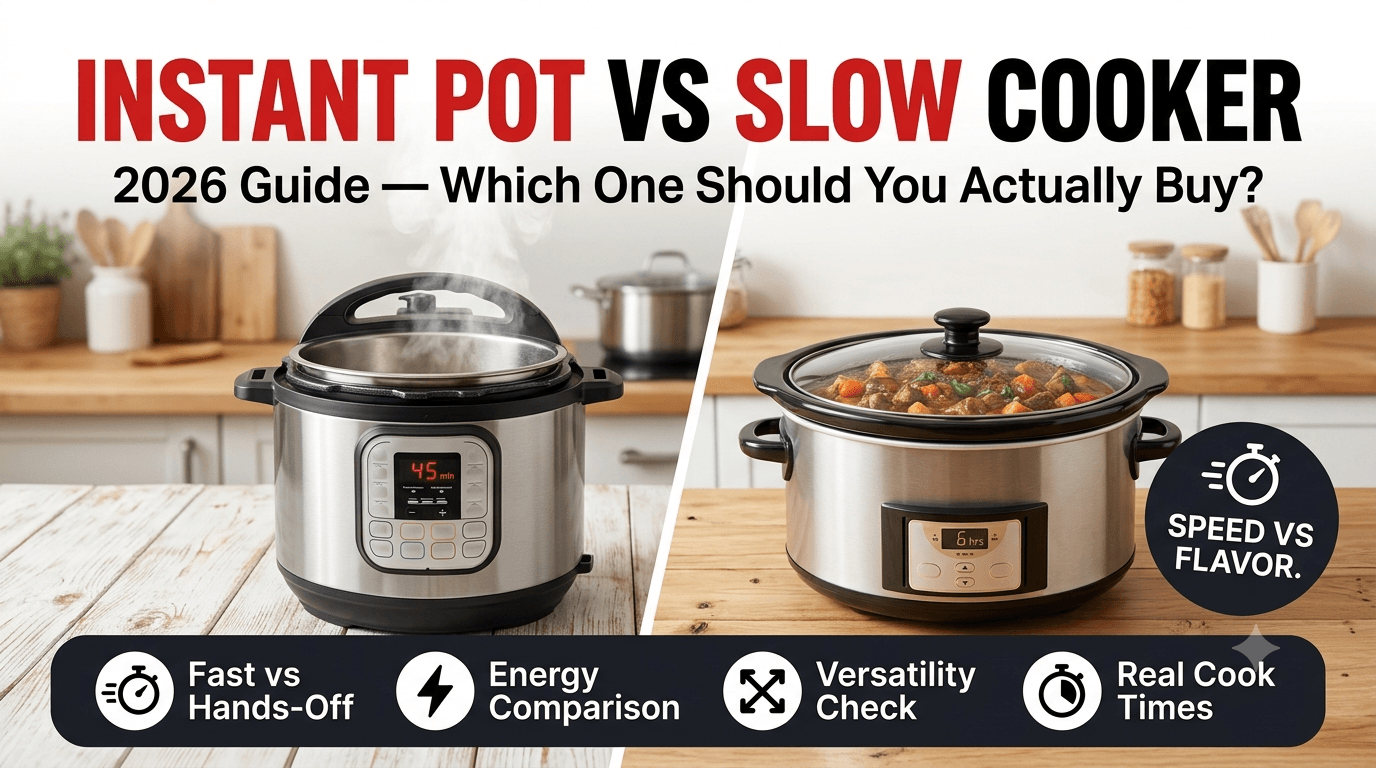
Instant Pot vs Slow Cooker in 2026 — Which One Should You Actually Buy?
The instant pot vs slow cooker debate comes up every time someone stands in the appliance aisle wondering whether these two are basically the same thing — they look similar, they both make “set it and forget it” meals, and the marketing for both promises tender, flavorful results. They’re actually fundamentally different cooking methods, and the right choice depends more on your schedule than on which one is “better.”
Quick Comparison Table:
| Factor | Instant Pot | Slow Cooker |
|---|---|---|
| Cooking method | High-pressure, sealed cooking | Low, gentle heat over hours |
| Typical cook time | 30-60 minutes | 4-8 hours |
| Speed vs conventional cooking | ~70-75% faster | Similar to oven, just hands-off |
| Electricity use | Higher for pressure cook cycles | ~18% less per meal on long cooks |
| Versatility | Pressure cook, slow cook, rice, steam, yogurt, sauté | Primarily slow cooking only |
| Best for | Weeknight speed, small kitchens | Hands-off all-day cooking |
The Real Difference: Speed vs. Set-and-Forget
An Instant Pot cooks by trapping steam in a sealed chamber, raising the internal pressure and boiling point well above 212°F. This is what makes a pot roast that would take hours in an oven finish in under an hour — independent testing has found Instant Pots score dramatically higher on time-to-table speed compared to slow cookers across identical meals.
A slow cooker does the opposite: it uses gentle, consistent low heat (typically 180-210°F) over 4-8 hours, letting flavors develop slowly without any pressure involved. Neither method is objectively better — they’re solving different problems. One is for “I need dinner in 45 minutes,” the other is for “I want to start this before work and come home to a finished meal.”
Where Slow Cookers Actually Win
Genuinely lower energy use is one real slow cooker advantage — testing has shown roughly 18% less electricity per meal on long-cook recipes compared to running a full pressure-cook cycle. If you’re cooking something that’s traditionally a long, slow process anyway (pulled pork, a pot roast you don’t need until dinner), a slow cooker isn’t just simpler, it’s genuinely more efficient for that specific task.
There’s also a flavor consideration worth knowing. Because pressure cooking happens in a sealed environment with minimal evaporation, broths and liquid-heavy dishes can come out slightly more diluted compared to a slow cooker’s slower reduction over hours. It’s a subtle difference, but noticeable in soups specifically.
If soup is your main reason for choosing between the two, we’ve put together a dedicated guide on the best Instant Pot models specifically for soup and stew season.
Where Instant Pot Wins (Most of the Time)
Versatility is the biggest factor. A true Instant Pot isn’t just a fast slow cooker — it pressure cooks, slow cooks, steams, makes rice, and often includes yogurt and sauté functions in the same unit. For small kitchens without room for four separate appliances, this consolidation is genuinely valuable, not just a marketing bullet point.
Since most modern Instant Pot models include a dedicated slow cook function, you’re not actually choosing between the two — a single Instant Pot can operate as a slow cooker whenever you want the low-and-slow method, while still being available for pressure cooking speed on busy nights. This is why, if you can only buy one appliance, the Instant Pot tends to win on flexibility alone.
Instant Pot vs Slow Cooker: So Which Should You Actually Buy?
If your cooking style is mostly “start it in the morning, eat it after work” and you rarely need a fast weeknight dinner, a dedicated slow cooker is simpler and slightly more energy-efficient for that specific use case.
If you want one appliance that handles both fast weeknight meals and occasional slow-cooked dishes, an Instant Pot covers both jobs without needing two separate appliances taking up counter and cabinet space.
Check Price On Amazon — Instant Pot Duo 7-in-1
Instant Pot vs Slow Cooker: What Actually Matters Before You Buy
Don’t choose based on speed alone — factor in what you’re actually cooking most. Beans, rice, and tough cuts of meat benefit enormously from pressure cooking’s speed. Dishes where slow flavor development genuinely matters (some stews, certain broths) can still turn out slightly better with true slow cooking, even if an Instant Pot’s slow cook mode gets close.
Also consider your schedule realistically. A slow cooker’s biggest strength is being genuinely hands-off for 6-8 hours while you’re at work — an Instant Pot’s pressure cook function needs you home to start and finish the cooking process within an hour, since it’s not designed for unattended all-day operation.
For food safety guidance on both pressure cooking and slow cooking methods, check the USDA’s guidelines on safe food handling with electrical cooking appliances.
FAQ
In the instant pot vs slow cooker debate, can an Instant Pot replace a slow cooker completely?
For most recipes, yes — nearly all modern Instant Pots include a dedicated slow cook function. The main difference some cooks notice is subtle flavor development, since true dedicated slow cookers sometimes produce slightly better results on very long, low-and-slow recipes.
Is a slow cooker cheaper to run than an Instant Pot?
On long-cook recipes specifically, yes — testing has found slow cookers use about 18% less electricity per meal compared to a full pressure-cook cycle. For quick meals, the Instant Pot’s speed advantage often offsets this difference in practical terms.
Which is better for beginners, an Instant Pot or a slow cooker?
When weighing instant pot vs slow cooker for beginners, a slow cooker has a slightly gentler learning curve since there’s no pressure release process to learn. An Instant Pot has more of an initial learning curve (venting, sealing, natural vs. quick release) but offers significantly more versatility once you’re comfortable with it.
Prices mentioned are approximate and may vary. Always check current Amazon pricing before purchasing. Some links on this page may be affiliate links — we earn a small commission at no extra cost to you.
Also read: Best Instant Pot Pressure Cookers in 2026, and our full range of air fryer guides including Air Fryer vs Deep Fryer vs Convection Oven, Best Air Fryers Under $50, and Best Smart WiFi Air Fryers with Alexa in 2026.