
Zojirushi vs Cuckoo vs Tiger: The Honest 10+ Year Durability Comparison
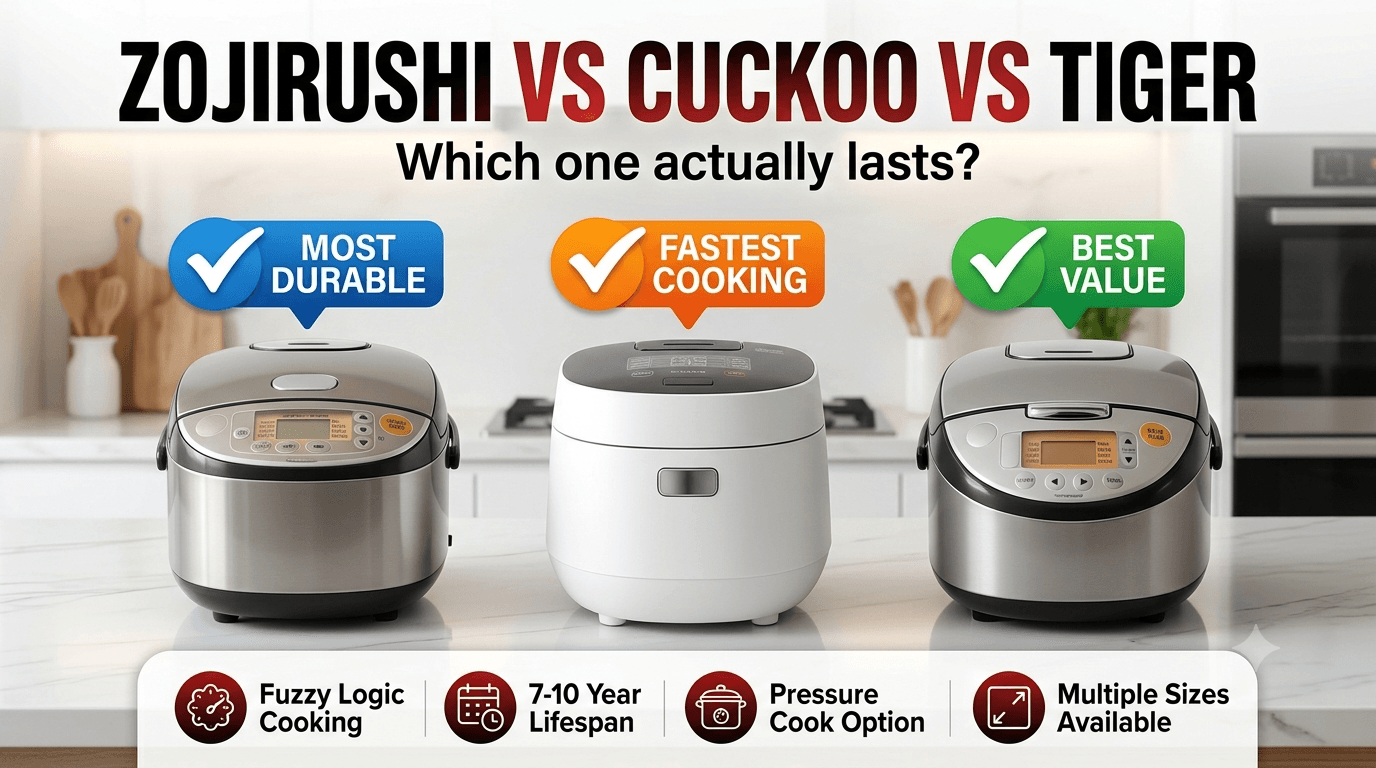
Zojirushi vs Cuckoo is one of the most common debates in any rice cooker forum, with Tiger not far behind. Strip away the brand loyalty, though, and the real question is which one actually survives daily use for the next decade — and whether fuzzy logic is worth the extra money or just a marketing term stuck on the box.
Short answer: fuzzy logic is real, and durability varies more by brand than most buying guides let on. Here’s what actually separates Zojirushi, Tiger, and Cuckoo once you get past the spec sheets.
What Fuzzy Logic Actually Does
Fuzzy logic isn’t just a fancier way of saying “has a timer.” It’s a small onboard computer that reads temperature and moisture changes while the rice cooks and adjusts heat and timing in response, instead of running a fixed program from start to finish. That’s the specific reason a fuzzy logic cooker can compensate for a slightly-off water ratio, while a basic on/off cooker just keeps going and leaves you with a dry bottom and a mushy top. It’s a genuine functional difference, not just a badge on the box — the same underlying fuzzy control system approach shows up in everything from washing machines to robotics.
With that mechanism in mind, here’s how Zojirushi vs Cuckoo — and Tiger — actually compare in practice.
Zojirushi: Built for the Long Haul
Zojirushi is the brand that popularized fuzzy logic in the US market, and its reputation for durability tends to hold up in practice — it’s not unusual to find owners who’ve had the same machine running for a decade or more without the inner pot needing replacement.
Part of that comes down to the coating quality itself, and part of it comes down to a small design detail that doesn’t get talked about much: many Zojirushi inner pots have side handles built in, which sounds minor until you’re the one lifting a hot, heavy pot out of the base every day for years without the handle mounts loosening up. If you want to see this in action, the Zojirushi NS-ZCC10 is a widely-reviewed example of exactly this reliability.
Tiger: Strong Performer, One Recurring Complaint
Tiger’s micom cookers hold their own against Zojirushi on cooking performance, but the inner pot coating has a specific complaint attached to it that shows up often enough to be worth mentioning: some owners report small black spots developing on the non-stick surface over time. Tiger’s customer service has apparently treated this as normal wear rather than a defect, and replacement isn’t covered — worth knowing going in, even if it’s not something every unit runs into. The Tiger JAX-T10U-K is a solid representation of what this brand offers at this level.
Cuckoo: A Different Philosophy Entirely
Cuckoo doesn’t really compete on fuzzy logic in the same way — its premium lineup leans on pressure cooking instead, which speeds up cook time and changes the rice’s texture rather than fine-tuning temperature curves the way Zojirushi does. If you’re weighing a dedicated rice cooker against a multi-cooker entirely, it’s worth reading how rice cookers compare to the Instant Pot more broadly first.
Most of its popular models, including its best-selling pressure cookers, use a stainless base with a nonstick coating on top — so despite the “stainless” branding, coating wear complaints do show up here too, similar to Tiger. A handful of newer, higher-end Cuckoo models skip the coating entirely for a bare stainless pot, if avoiding that tradeoff matters to you. Either way, the more consistent ongoing cost is on the pressure-sealing side — the rubber gasket needs replacing every 2-3 years. It’s a cheap part, but it’s a maintenance cost the other two brands don’t really have. The Cuckoo CRP-P0609S is one of the most popular examples of this approach, with thousands of reviews to back it up.
Zojirushi vs Cuckoo vs Tiger: Side-by-Side
| Zojirushi | Tiger | Cuckoo | |
|---|---|---|---|
| Technology | Fuzzy logic (temperature/time) | Fuzzy logic (temperature/time) | Pressure cooking |
| Inner pot durability | Strong reputation, side-handle design | Coating can develop spots over time | Most models coated (similar wear reports); bare-stainless option available |
| Ongoing maintenance | Minimal | Minimal | Gasket replacement every 2-3 years |
| Best for | Long-term reliability with minimal fuss | Similar performance, often at a lower price | Faster cooking, different texture preference |
Bottom Line
So, Zojirushi vs Cuckoo really comes down to philosophy: Zojirushi’s track record is hard to argue with if durability with the least amount of thinking about it is the priority, while Cuckoo trades that simplicity for faster cooking and a different texture, plus a small, predictable gasket-replacement cost down the line. Tiger sits alongside Zojirushi on performance and often costs less, if you can live with a coating that might show its age eventually. None of these are wrong choices; it comes down to which tradeoff you’d rather live with.
FAQ
Is fuzzy logic worth paying extra for?
If you cook rice several times a week and want consistent results without babysitting the water ratio, yes — it’s a real functional upgrade, not just marketing.
How does Zojirushi vs Cuckoo compare on long-term durability?
Most well-maintained units from these three brands run 7-10 years before anything needs attention, and some owners report a decade or more.
Does Cuckoo’s gasket really need replacing that often?
Every 2-3 years is the general guidance for pressure models, and it’s a low-cost part — but it is an ongoing cost the other two brands don’t have.
Can I use a smaller-capacity model from any of these brands?
Yes — all three make compact versions suited to cooking 1-3 cups regularly, so you don’t need to size up just to get the durable build.